The Effectiveness of Digital Marketing in Today’s World
How businesses are winning customers, growing revenue, and building lasting brands through the power of digital strategy in 2026.
Table of Contents
- Why Digital Marketing Matters Now More Than Ever
- Search Engine Optimisation (SEO)
- Social Media Marketing
- Content Marketing
- Email Marketing
- Paid Advertising (PPC)
- Video Marketing
- AI and Automation in Marketing
- Conclusion
Why Digital Marketing Matters Now More Than Ever
The world has moved online — and businesses that have not followed are paying the price. Digital marketing is no longer a supplementary strategy; it is the primary engine of business growth in 2026. From a local bakery to a multinational enterprise, the tools of digital marketing have democratized access to customers in ways that were unimaginable a decade ago.
The numbers tell an undeniable story. Global digital ad spending is on course to hit $734.6 billion, and for every $1 spent on digital marketing, businesses typically earn a $5 return. The global market value of digital marketing is projected to reach around $1.3 trillion by 2033, cementing its place as the defining commercial infrastructure of our era.
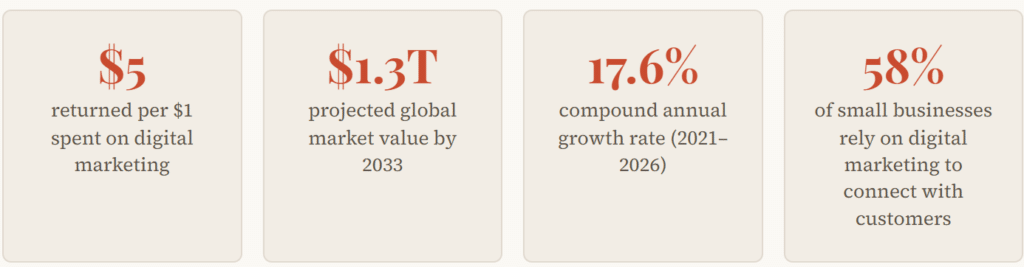
of small businesses rely on digital marketing to connect with customers
This article breaks down the key channels driving that growth, the statistics that prove their effectiveness, and the practical strategies businesses are using to win in an increasingly competitive digital landscape.

Modern digital marketing combines data, creativity, and technology to reach the right audience at the right moment.
Search Engine Optimisation (SEO)
SEO remains the single most powerful driver of online visibility. SEO dominates with 93% of web traffic originating from search engines — making it the backbone of any digital strategy. Unlike paid advertising, organic search delivers compounding returns: a well-optimised page continues to attract visitors months and years after it was published, without ongoing spend.
SEO drives 53% of all website traffic, and programmatic advertising is expected to cover 87% of all digital ad revenue by 2026. Businesses that invest in SEO are not just chasing rankings — they are building a durable asset that grows in value over time.
“Organic search is not just a channel — it is the foundation on which every other digital marketing effort stands.”
In 2026, SEO has evolved significantly. The year is characterised by the integration of Generative AI and the emergence of “Position Zero” through AI-generated overviews. This means businesses must now optimise not just for traditional blue-link rankings, but for featured snippets and AI answer panels that appear before any other results.
Key SEO strategies that are working right now
- Topical authority:Publishing comprehensive, interlinked content clusters that establish your site as the definitive source on a topic.
- Core Web Vitals:Page speed, visual stability, and interactivity are direct ranking factors — technical SEO is non-negotiable.
- E-E-A-T signals:Google prioritises Experience, Expertise, Authoritativeness, and Trustworthiness — especially for health, finance, and YMYL topics.
- Conversational and long-tail queries:Voice search and AI assistants have shifted search patterns toward natural language queries.
Pro Insight
Mobile-friendly optimisation is crucial — 61% of users are more likely to contact a business with a mobile-optimised site. If your site is not fast and responsive on a phone, you are losing more than half your potential customers before they even read a word.
Social Media Marketing
With billions of users scrolling through feeds every day, social media has become one of the most powerful channels for brand discovery, community building, and direct sales. Adults spend over 2.5 hours daily on social platforms, and 40% of B2B marketers cite LinkedIn as the top source for high-quality leads.
Nearly every online consumer — 97% — checks in with social media every month, making it a prime target for digital marketers. Social platforms are no longer just for awareness; they are full-funnel sales environments where users discover, research, and purchase products without ever leaving the app.

Social media dashboards give marketers real-time visibility into audience behaviour, engagement rates, and campaign performance.
Social media advertisement spending has surpassed $230 billion — a figure that reflects not just scale, but the maturity of targeting capabilities. Platforms like Meta, TikTok, and LinkedIn now offer granular audience segmentation that was once only available to major corporations with enormous research budgets.
Platform spotlight: TikTok’s algorithm-driven discovery model means even accounts with zero followers can reach millions with a single piece of compelling content. For brands targeting under-35 audiences, it is arguably the most effective organic reach available today.
Content Marketing
If SEO is the foundation and social media is the megaphone, content marketing is the substance that holds everything together. Every blog post, infographic, case study, and podcast episode is an asset that builds trust, educates your audience, and moves them closer to a purchase decision.
The global content marketing industry is estimated to generate $94 billion in revenue in 2025, and is expected to grow 10.4% in 2026. Statista expects global content marketing revenue to reach $107 billion by 2026, highlighting its significance as a primary pillar of the digital economy.
Research from the Content Marketing Institute shows that 61% of marketers have seen their content strategy’s effectiveness improve, primarily due to greater reliance on quality content and refined team skills.
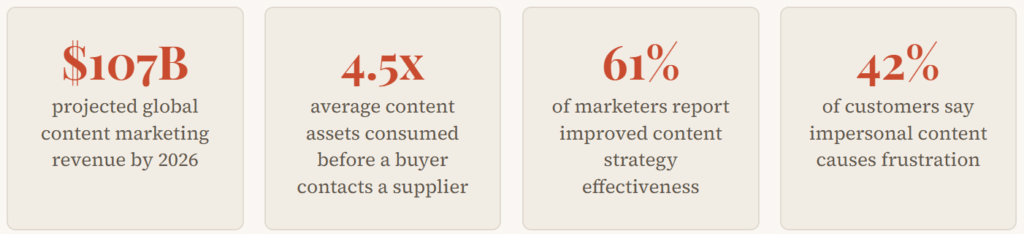
of customers say impersonal content causes frustration
The lesson is clear: personalisation is no longer optional. 42% of customers say impersonal content causes frustration, and with AI-powered personalisation tools now accessible to businesses of all sizes, there is no excuse for generic, one-size-fits-all content.
Email Marketing
Email is the oldest channel in digital marketing — and by several measures, still the most effective. While social media trends come and go, an email list is an asset you own outright. No algorithm can cut off your reach overnight.
Email marketing delivers a remarkable 4,400% ROI, and on average, the return is $38 for every dollar invested. Marketers have witnessed an increase of 760% in email revenue from properly segmented campaigns — meaning the difference between a mass-blast and a targeted sequence is not marginal; it is transformational.

Email marketing remains the highest-ROI digital channel — and segmented, personalised campaigns multiply those returns by hundreds of percent.
“For every $1 spent on email marketing, businesses earn $38 back. No other marketing channel comes close.”
The number of emails sent and received per day is expected to rise to 392 billion by 2026, and 72% of consumers prefer their marketing communication to be via email over other channels. This is not a dying medium — it is a thriving one, with extraordinary reach and the highest consumer preference of any digital channel.
Paid Advertising (PPC)
Pay-per-click advertising offers what few other channels can: immediate, measurable results. Whether through Google Ads, Meta Ads, or programmatic display, paid advertising allows businesses to put their message in front of precisely defined audiences at exactly the right moment.
84% of brands say they see positive results with PPC advertising campaigns, and 80% of companies use Google Ads as part of their paid strategy. Effective PPC optimisation yields average returns of $2 for every $1 spent, and over 75% of marketers plan to increase or maintain their search and display ad investment in 2026.
- Google Search Ads:Capture high-intent buyers actively searching for your product or service. Cost-per-click can be high in competitive categories, but conversion rates are typically the strongest of any paid channel.
- Meta Ads:Unmatched audience targeting by interest, behaviour, and lookalike audiences. Particularly effective for visual products and impulse purchases.
- Programmatic Display:Automated buying of ad inventory across millions of sites, optimised in real-time by algorithms. Programmatic advertising is expected to cover 87% of all digital ad revenue by 2026.
- Retargeting:Re-engaging visitors who left without converting is one of the most cost-efficient tactics available — these users have already shown interest.
Critical Insight
50% of users cannot distinguish paid ads from organic search results — which underscores the importance of combining both SEO and PPC for maximum visibility across the entire search results page.
Video Marketing
Video has moved from a “nice to have” to an absolute necessity. A massive 91% of businesses now use video as a primary marketing tool, and 82% of video marketers report a strong ROI in 2026. The medium is uniquely suited to the way people consume information today — in short, visually engaging bursts that communicate emotion and information simultaneously.
Static text is evolving into “experiential content.” In 2026, if your content isn’t moving or talking, it is likely being overlooked. Short-form video on TikTok, Instagram Reels, and YouTube Shorts commands the highest organic reach of any content format, while long-form video builds deep trust and authority.

Video marketing is now essential — 91% of businesses use it as a primary tool, and the ROI continues to strengthen year on year.
AI and Automation in Marketing
Artificial intelligence is reshaping every corner of digital marketing — from content creation to customer service, audience targeting to campaign optimisation. Businesses that embrace AI are not just saving time; they are unlocking capabilities that were previously impossible.
84% of marketing organisations now use AI and machine learning in some capacity, with 48% utilising it specifically for predictive analytics. HubSpot’s 2025 State of Marketing Report reveals that 30% of marketers are now using AI specifically for data analysis and insights — allowing them to anticipate customer needs before they are even expressed.

productivity gain reported from AI adoption
Automation drives ROI by slashing manual costs and boosting productivity. Businesses that adopt marketing automation average a 240% return, often recouping costs within nine months. Top performers following best practices reach up to 390% ROI through optimised workflows.
AI is revolutionising marketing productivity — 85% of marketing tasks are now automatable, delivering a 32% productivity gain for organisations that implement them properly. From automated email sequences to AI-generated ad copy testing, the competitive advantage is real and measurable.
Conclusion: The Digital Advantage Is Real
Digital marketing is not a trend — it is the permanent reality of how businesses and customers find each other. The statistics paint a consistent picture: businesses that invest thoughtfully in digital strategy — across SEO, social media, content, email, paid advertising, video, and AI — outperform those that do not by every measurable metric.
The brands winning today are not necessarily those with the biggest budgets. They are the ones with the clearest strategy, the most relevant content, and the willingness to learn from data and adapt. Brands that successfully combine operational excellence through automation and data, authenticity through human content and reviews, and a multi-channel strategy will stand out sustainably.
Whether you are a startup building your first digital presence or an established business refining a mature strategy, the opportunity has never been greater. The tools are accessible, the data is available, and the returns are proven. The only question is how committed you are to executing well.
“The businesses that master digital marketing today are not just winning sales — they are building the brands that will define the next decade.”